A free, section-by-section marketing proposal template — plus examples, format, and the one rule that separates a winning proposal from a generic one.
Written by Umut SeyarcıPublished June 22, 20268 min read
AI summary
A marketing proposal template fixes the winning structure — executive summary, situation analysis, strategy, scope of work, timeline, pricing, and next steps — so you tailor content per client without rebuilding the format. But the template alone loses: it standardizes the format, not the persuasion, so it is a starting point for the personalization that closes, never the finished document.
The template fixes nine sections so you adapt content, not format, per client.
The scope-of-work section, with explicit exclusions, is where the deal is won.
A template standardizes the format; the personalized content is what wins the work.
Personalize the opening line to the client's specific problem, not a generic claim.
Adapt the same structure by channel — SEO, social, content, or full digital.
Add the line most templates omit: which accounts, files and dashboards the client owns, and what is handed over at the end.
Agencies and freelancers who want a reusable proposal structure that still wins.
New-business teams standardizing how they pitch without sounding templated.
This summary was generated by AI from the article and reviewed before publishing.
A marketing proposal template is a reusable structure for the document you send to win a client:
executive summary, situation analysis, strategy, scope of work, timeline, pricing, proof, and a
next step. It saves you from the blank page so you tailor the content to each prospect — but the
template is a starting point, never the finished proposal, because personalized proposals win far
more often than templated ones.
A good template removes the busywork of formatting so your energy goes into the part that closes: the client's specific problem and your specific plan. Below is the full section-by-section structure you can copy, the formats and examples that work, and the one rule that keeps a template from costing you deals. You can adapt it per service — the SEO proposal and the multi-channel digital marketing proposal both use this skeleton.
Audio brief: the marketing proposal template
AI-generated audio summary of this article, created with Google NotebookLM.
The free marketing proposal template, section by section
Copy this structure into your document of choice. Each section has one job:
Executive summary — the client's goal, your approach, and the expected business result, in a few sentences. Write this last, read it first.
Situation analysis — a short, specific read of where they are now. This is where you prove you studied them.
Strategy — the approach tailored to their problem, not a list of everything you offer.
Scope of work — the definitive deliverables list, with explicit exclusions. The decisive section.
Timeline and milestones — phased, with early quick wins flagged so progress is visible.
Reporting and KPIs — the metrics you'll track and how often you'll review them.
Proof — case studies or results from comparable clients.
Investment — pricing framed against the value created, not presented as a bare number.
Next steps — a single, low-friction action that moves to a yes.
Then add the line almost every circulating template leaves out: who owns what. Name the accounts, properties, source files and dashboards that belong to the client, and what gets handed over at the end of the engagement. Business owners raise this in the same breath as price, because it is the same question asked about the exit rather than the entry — and answering it unprompted costs you no leverage while removing the sense that signing is irreversible.
Examples and formats that win
Format follows the buyer. A few practical rules:
Match the medium to the deal. A small retainer can close on a clean two-page document; an enterprise pitch may warrant a designed deck. Don't over-produce a simple sale or under-produce a complex one.
Lead with the client, not your logo. The first thing the reader should see is their problem, framed in their words.
Make it scannable. Headers, short paragraphs, and a visual or two — a wall of text reads as effort the buyer has to spend, not effort you saved them.
A useful example is two versions of the same opening line: a generic one and a personalized one. The difference is the whole game, which is why the next section matters more than the template itself.
Why a template alone loses: personalize or lose
Here's the uncomfortable truth behind every "free template" download. A template gives you structure, not persuasion — and the gap between a templated proposal and a personalized one is what the client actually reads:
Why the template is a starting point, never the finished proposal.
Approach
Generic template
Personalized from the template
Opening line
We help brands grow with marketing.
Your cost-per-lead is double the category median — here's the fix.
Situation section
A generic paragraph about the industry.
Their numbers, their competitors, their specific gap.
What the client feels
This could have been sent to anyone.
They actually studied my business.
The structure is reusable; the content never is. The template's value is speed — it frees you to spend your time on the personalization that actually closes, not on formatting. There is no credible published win-rate figure for templated versus customized proposals (the numbers that circulate trace back to AI-generated content farms, not measured studies), but the mechanism is not in doubt: a proposal a prospect recognizes as written for them beats one they recognize as a form.
Adapting the template by channel
The same skeleton flexes to any engagement. For a single-service pitch, the scope and proof narrow to that channel — see the SEO proposal structure, or the social media proposal and web design proposal versions, each of which pins down the scope variables specific to that service. For a bundled engagement, the strategy and scope sections expand to tie channels together — the digital marketing proposal covers that. The sections stay; the depth shifts.
Use the template, then make it personal fast
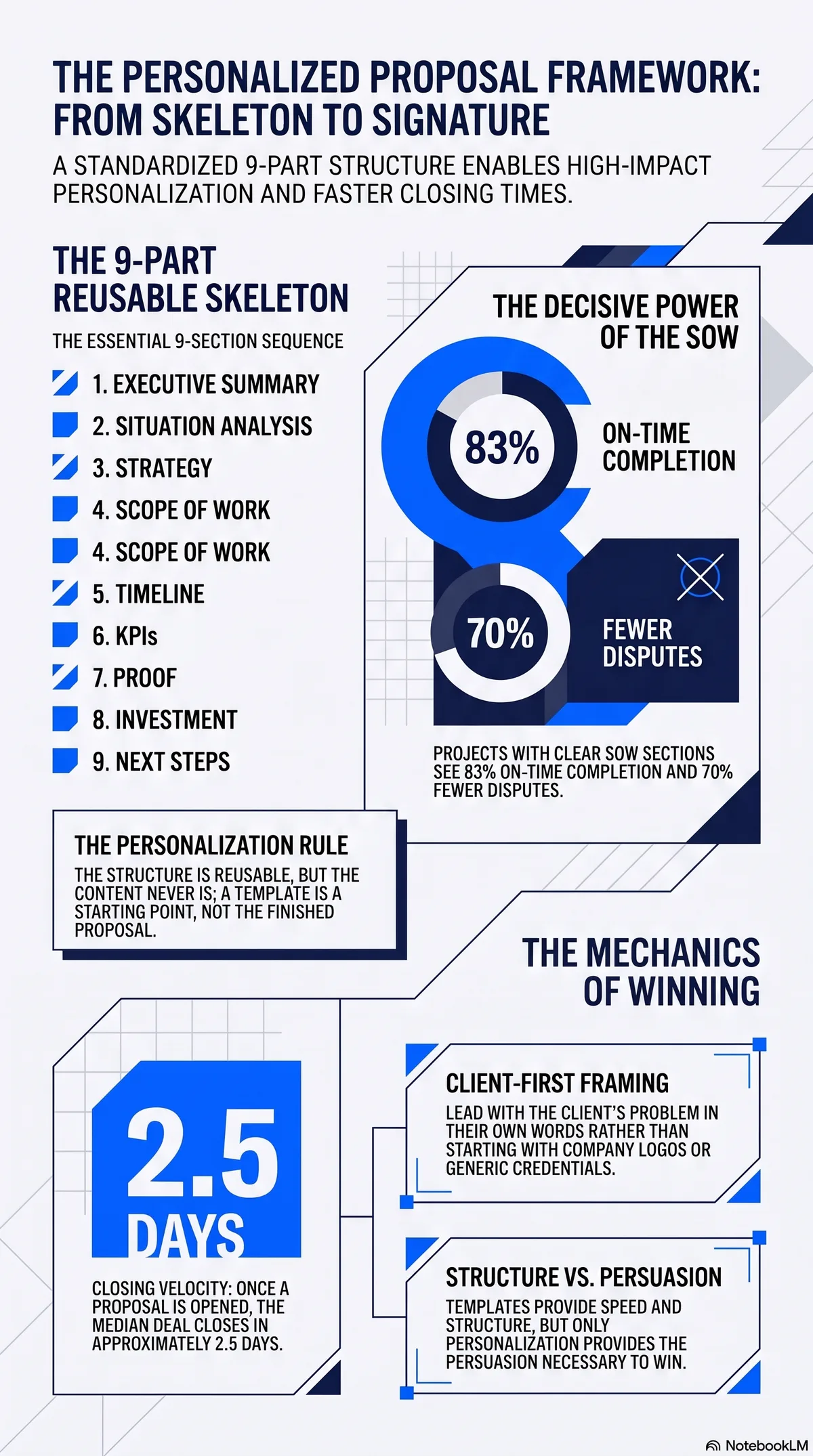
The catch with personalization is time: tailoring every proposal by hand is slow, which is exactly why agencies fall back on the generic version and lose. The fix is to make a tailored draft cheap — generate it from the prospect's own URL, then edit. Pitchko turns a prospect's site into a personalized proposal in minutes, so you get the speed of a template and the win rate of a custom document. Sending that tailored proposal while the conversation is fresh is its own advantage — in Proposify's platform data, an opened proposal averages about 2.5 days to close, so momentum matters. The template gets you to the draft; speed and personalization get you the signature.
The winning marketing proposal: structure plus personalization — visual summary generated with Google NotebookLM.
Frequently asked questions
What is a marketing proposal template?
A marketing proposal template is a reusable structure for the document an agency or freelancer sends a prospect to win the work. It fixes the sections — executive summary, situation analysis, strategy, scope, timeline, pricing, and next steps — so you tailor the content to each client without rebuilding the format every time.
What should a marketing proposal include?
An executive summary tied to the client's goal, a short situation analysis, your strategy, a precise scope of work with exclusions, a timeline with milestones, reporting and KPIs, proof or case studies, pricing framed as investment, the team, and a clear next step. Specific deliverables and a defined scope are what move a proposal from a quote to a plan.
How long should a marketing proposal be?
Long enough to define the work precisely, short enough to respect the buyer's time — usually a few focused pages. Length is not the signal of quality; specificity is. Cut anything that doesn't help the client decide.
Is a free marketing proposal template enough to win the deal?
No. A template gives you the structure, not the win. It standardizes the format so your time goes into the part that actually closes — the client's specific problem, numbers, and goal. Use the template to start fast, then personalize the content, because a proposal that reads as if it could have been sent to anyone rarely wins the work.
Most web design proposals lose money not because the price was wrong but because the scope was silent. Here's the structure — and the specific clauses — that decide whether month three is profitable.
Social media is the easiest service to scope badly. Undefined revision rounds, vague 'engagement', and free community management turn a signed retainer into an unprofitable one — here's the proposal structure that prevents it.
A digital marketing proposal has to do something a single-channel pitch doesn't: tie SEO, ads, social, and content into one plan a client can approve. Here's the structure — and the proposal data — that does it.