A digital marketing proposal is a structured document an agency sends a prospect to win a multi-channel engagement. It ties the strategy across channels — SEO, paid ads, social, content — into one plan with a per-channel scope of work, a timeline, measurable KPIs, and pricing that separates your fee from media spend. It wins by proving accountability before a dollar is spent, not by listing services.
A digital marketing proposal has a harder job than a single-service pitch. It has to make several channels read like one coherent plan — not a stapled-together SEO retainer, ads retainer, and social retainer. The structure below is what turns that complexity into a document a client can approve, and you can start from a reusable marketing proposal template and adapt it per engagement.
AI-generated audio summary of this article, created with Google NotebookLM.
The seven sections of a winning digital marketing proposal
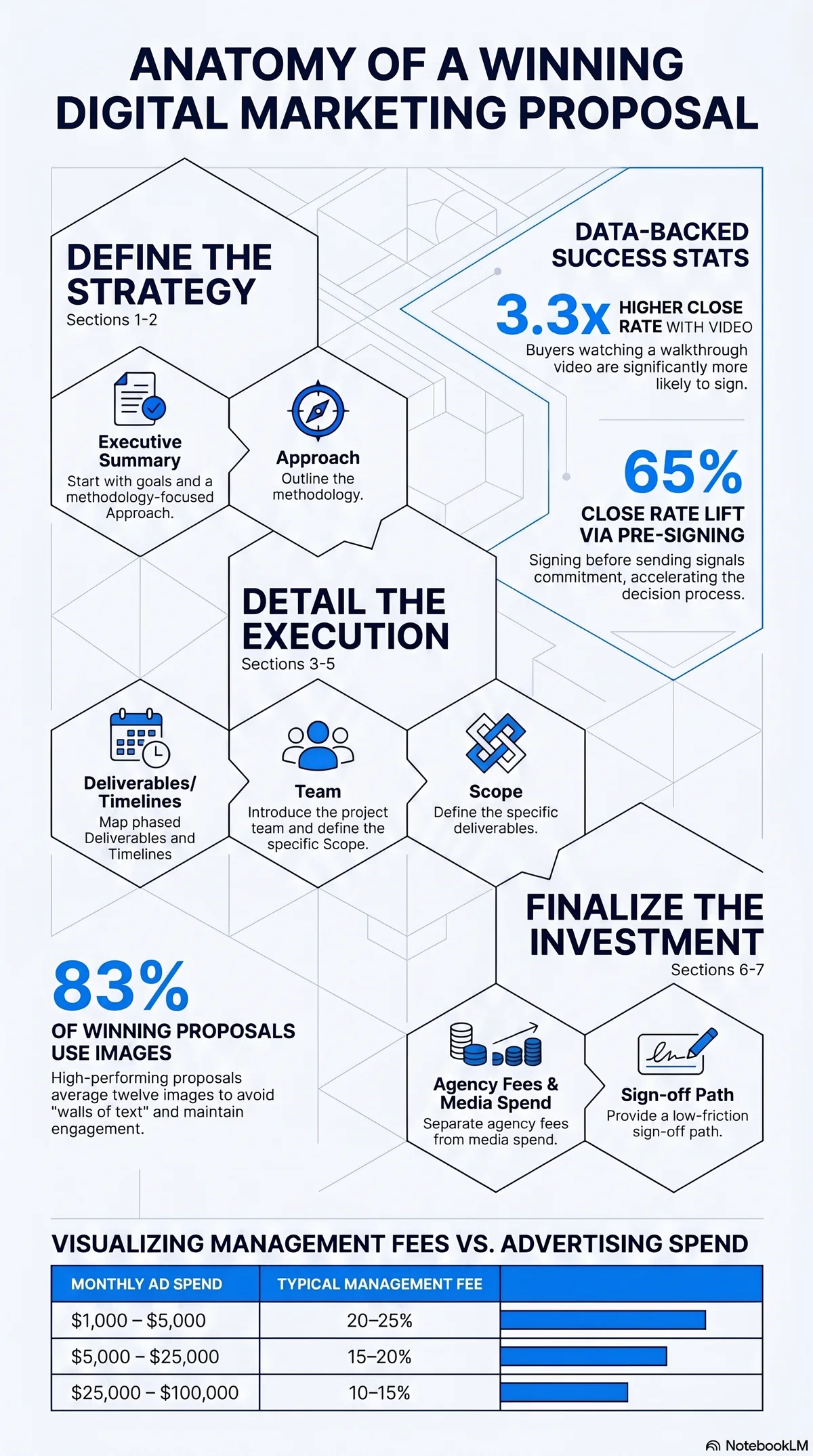
Winning proposals are remarkably consistent in shape — proposal data puts the average at around seven sections. Use this order, each section with one job:
- Executive summary — the client's business goal, your cross-channel approach, and the expected result, in a few sentences.
- Approach — the methodology and the specific expertise you'll apply to their problem, not a list of everything you offer.
- Deliverables and timeline — phased, with early quick wins flagged so progress is visible.
- Team and proof — the strategists on the account, plus case studies with real metrics.
- Scope of work — the definitive per-channel deliverables list, with explicit exclusions. The decisive section.
- Investment — pricing framed against value, with your fee separated from media spend.
- Terms and sign-off — objective acceptance criteria and a low-friction path to a yes.
A visual matters more than agencies expect: 83% of winning proposals include images, averaging twelve. A wall of text is a missed advantage.
Scoping multiple channels without losing the client
The section that wins or loses a digital marketing proposal is the scope of work, because vague multi-channel scope is where agency margins quietly disappear. In a survey of 5,402 project professionals, two of the three leading causes of project failure were change in project objectives and erroneous requirements gathering — both scope-definition failures, and both prevented by agreeing what "finished" means before work starts.
The fix is to write each channel's scope as a specific, countable deliverable instead of a category. Each channel has its own scope variables worth pinning down individually — the social media proposal guide covers content origination and community-management coverage, and the web design proposal guide covers revision rounds and the two-tier change clause:
| Proposal line | Vague (loses) | Specific (wins) |
|---|---|---|
| Channel scope | Full-funnel digital marketing management. | SEO: 20 priority pages plus technical fixes. PPC: 2 Search campaigns on a $4k/mo media budget. Social: 12 posts/mo across 2 channels. |
| Reporting | Monthly performance reports. | One dashboard tracking CPL, ROAS, and organic conversions, reviewed monthly. |
| Exclusions | Not stated. | Excludes creative production, landing-page development, and media spend above the agreed budget. |
Naming exclusions isn't defensive — it signals you run disciplined projects, and it stops a "quick favor" three months in from eroding your margin. A scope of work also has teeth: once it's signed alongside a master services agreement, it becomes a binding commitment, which protects both sides.
Say who owns the accounts
The scope answers what gets done. It should also answer what the client keeps, and almost no proposal does. Ask business owners what they wish they had known before hiring an agency and ownership surfaces fast, usually phrased as advice to the next buyer: get full access to everything, and own your own assets. It comes up in the same breath as price, because it is the same question — what am I actually buying.
So state it, in the scope, before anyone has to ask:
- Ad accounts and properties — the client's own Google Ads, Meta Business Manager, GA4 and Search Console, with your team added as users. An agency-owned ad account means the campaign history walks out with you.
- Creative and content — who holds the source files, and what licence transfers on final payment.
- Dashboards and automations — whether the reporting view survives the engagement or dies with your subscription.
- Offboarding — what gets handed over, in what format, within how many days of termination.
None of this costs you leverage. A client who can see the exit is measurably easier to sign, because the decision stops being irreversible — and the agencies that resist the question are the ones the advice is warning them about.
Pricing: separate your fee from media spend
A client who can't tell what they pay you versus what goes to the ad platforms will anchor on the total and balk. Spell it out: "agency management fee: X, recommended media budget: Y." For paid channels, management fees commonly land in a predictable band as a share of spend:
| Monthly ad spend | Typical management fee |
|---|---|
| $1,000 – $5,000 | 20–25% |
| $5,000 – $25,000 | 15–20% |
| $25,000 – $100,000 | 10–15% |
| $100,000+ | 8–12% |
Frame the figure against the alternative. Organic and owned channels compound, while paid traffic stops the moment the budget does — so position the engagement as building durable assets, not renting attention.
What actually moves the win rate
The proposal itself is a lever, not just a formality. In platform data from proposal-software vendor Proposify, drawn from 742,137 proposals, the average close rate is 34% — and the documents above that line share specific, repeatable traits. (These are the vendor's own 2026 figures, self-reported from proposals sent through its platform, so read them as directional rather than universal.)
- Add a personalized video. When a buyer watches a walkthrough video, the proposal is 3.3x more likely to close. It's the single highest-leverage addition.
- Pre-sign it. Signing the proposal before you send it lifts the close rate by 65% and closes 25% faster — it signals commitment and removes a step.
- Send it fast. The time from a buyer opening a proposal to a decision averages 2.5 days; a document that arrives while the conversation is warm rides that momentum.
Reporting is your competence proxy
Here's the part most agencies underweight. The reporting section isn't about data — it's about removing the client's future anxiety. Uncertainty is what drives a client to second-guess the relationship, and a proposal that promises a clear, automated view of the metrics that matter reads as professional competence before any work begins. Show them the dashboard they'll get, name the KPIs (revenue-aligned, not vanity clicks), and set the review cadence. You're not just proposing work; you're proposing peace of mind.
Deal-killers that get a proposal rejected
Run the document through this checklist before you send it:
- Guaranteed rankings. Promising a #1 spot on Google signals inexperience to an informed buyer.
- Vague deliverables. "Reasonable effort" instead of objective, measurable outputs.
- Hidden fees. Failing to separate media spend from management fees, or burying costs in jargon.
- Generic strategy. A proposal that ignores the client's specific market and customer journey.
- Vanity metrics. Reporting on clicks and impressions instead of revenue-aligned outcomes.
- Silent on ownership. No statement of who holds the ad accounts, analytics and creative files, or what happens to them at the end.
A faster path to a tailored proposal
The reason most agencies fall back on a generic template is time — a genuinely tailored multi-channel proposal is slow to build by hand. The shortcut is to generate the first draft from the prospect's own site, then edit, keeping the structure reusable while the specifics stay unique to the client. That's exactly what Pitchko produces from a single URL, so a proposal already shaped around the prospect's channels and gaps goes out while the conversation is still warm. Whether you start from the SEO proposal for a single service or this multi-channel structure, the rule holds: the template is reusable, the content never is.