You get SEO clients by building a small set of repeatable channels and working them on purpose: turn current clients into referrals, run free specific audits instead of cold pitches, demonstrate expertise where prospects already are, and convert interest fast with a same-day proposal. Specificity and speed win more retainers than cold-outreach volume.
Most agencies treat new business as a numbers game — more cold emails, more calls, more lists. The agencies that actually grow do the opposite: they build two or three channels that compound and run them deliberately. Below is the playbook, channel by channel, ending with the step where most deals are quietly lost: the proposal you send to close.
AI-generated audio summary of this article, created with Google NotebookLM.
What actually wins SEO clients in 2026
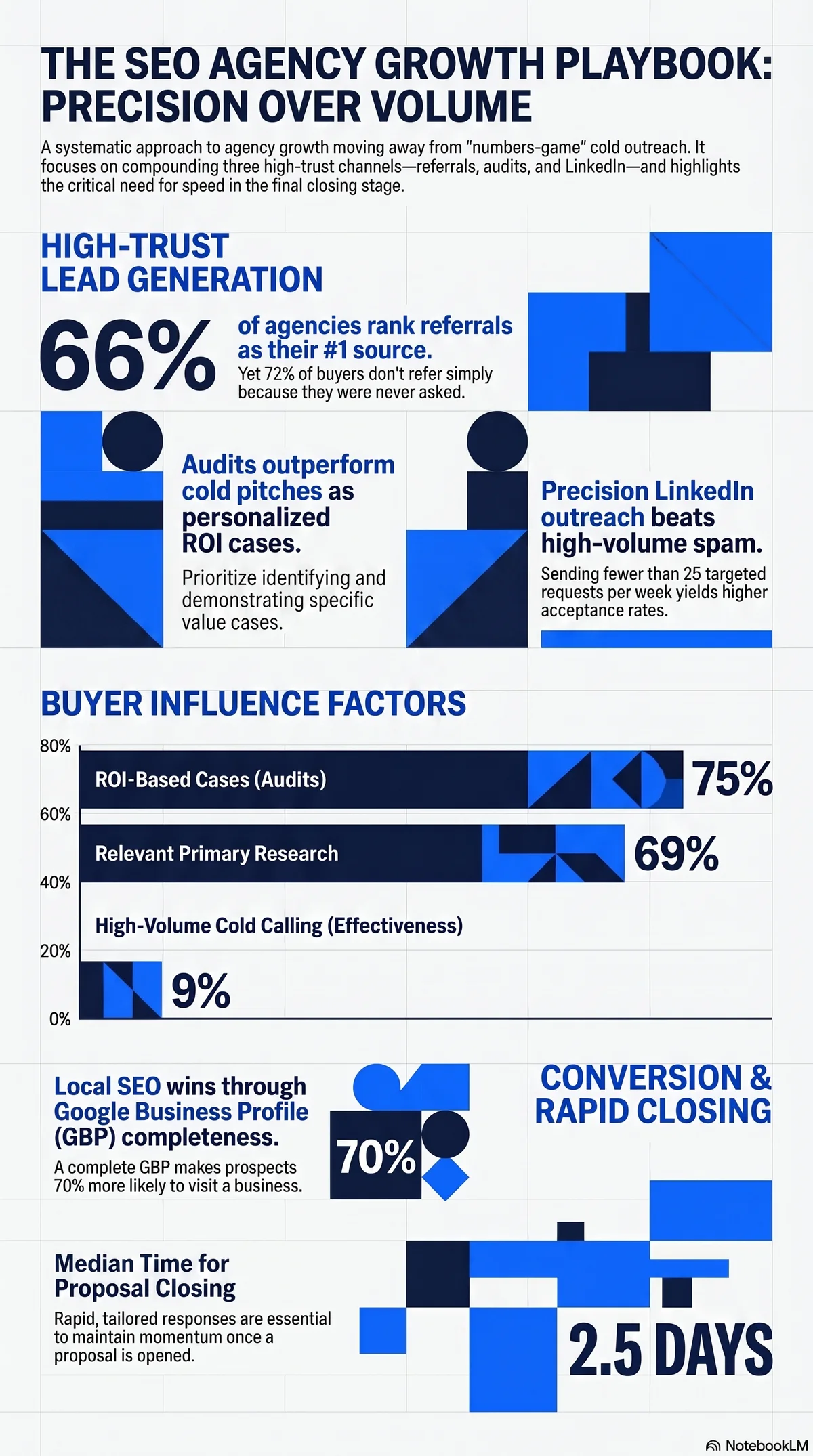
Referrals are the structural backbone of agency growth. In SparkToro and Paddy Moogan's survey, 66% of agencies named referrals their #1 new-business source, and the 2025 edition reported that unchanged. But two facts make the rest of this playbook necessary:
- Referral-only pipelines are fragile. Only a small share of agencies describe their pipeline as very healthy, and over-reliance on word of mouth leaves you exposed in a quiet quarter.
- Buyers vet you before they ever call. Hinge found that 51.9% of buyers have ruled out a referred firm before even speaking to them — most often because they couldn't tell what the firm actually did. A warm introduction still has to survive a cold look at your site.
So the goal is to manufacture more trust, prove expertise on demand, and respond faster than the competition — across a few channels, not one.
Turn current clients into a referral engine
Your existing clients are the highest-trust pipeline you own, and most agencies simply never ask. Hinge's referral research is blunt on the bottleneck: 72% of buyers are never asked about the firms they have worked with — the constraint is the ask, not their willingness. (That study dates from 2015; the mechanism has not changed, but treat the exact figure as a decade old.) Fix it with a system, not a one-off favor:
- Ask at the peak. Request the introduction right after a reporting call where the numbers were good — when goodwill is highest. Build the ask into your workflow so it happens every time.
- Name the target. "Do you know another clinic owner like you?" converts better than "know anyone who needs SEO?" Specific requests are easier to fulfill.
- Court non-clients too. Most providers get referrals from people who were never clients — peers who've seen you speak or read your work — so referability isn't limited to your current roster.
Get SEO clients without cold calling: audits and inbound
Cold calling resets to zero every morning; audit-led outreach accumulates. The most reliable replacement for the cold pitch is the free, specific audit: pick a target business, find one real problem — a slow Core Web Vitals score, a cannibalized keyword, a missing local listing — and show them the problem and what it costs.
This works because buyers respond to relevance, not volume. RAIN Group's research found that ROI cases influence 75% of senior buyers to accept a meeting, and primary research relevant to their business influences 69% — and an audit is essentially a personalized ROI case. Keep it tight and scannable so it doesn't turn into unpaid consulting: cover the main pillars, limit it to two or three key pages, and lead the follow-up with the one or two highest-impact fixes framed as lost revenue. A free audit lead magnet does the qualifying for you — the prospects who reply already see the gap.
How to get SEO clients on LinkedIn
LinkedIn is the social channel agencies rate most effective for new business — 73% name it their top channel for leads — but the 2025–2026 data shows a clear shift from volume to precision:
- Post from a personal profile, not the agency page. Publish proof-of-expertise content — teardowns, results, frameworks — rather than promotional posts.
- Target a short list, not the whole market. Build a focused list of 50 decision-makers. PhantomBuster's 2026 data found that senders of fewer than 25 connection requests a week saw higher acceptance rates than those maxing out the limits.
- Warm up before pitching. Engage with a prospect's posts for a week or two before any direct message, so the conversation starts familiar.
How to win local SEO clients
Local SEO clients — dentists, law firms, contractors, restaurants — buy on proximity and proof of local results. Win them with evidence they recognize:
- Use your own listing as the demo. Customers are 70% more likely to visit, and 50% more likely to consider purchasing from, a business with a complete Google Business Profile. A profile you've ranked into the local pack is a live case study.
- Show up in person. Speaking at local events and meetups has climbed into the top tier of referral drivers — many local owners still buy from people they've met.
- Audit their map presence. Local audits are fast and concrete — citations, reviews, GBP categories — which makes them an ideal door-opener for this segment.
Local is a different economic game from general SEO — it prices roughly 47% below the category, which changes which acquisition tactics can pay for themselves. The full treatment, including what local retainers actually cost and why project work predicts churn, is in the dedicated guide to getting local SEO clients.
Build a repeatable new-business system
One-off tactics don't compound; a system does. Pick two channels from above — say referrals plus audits — and commit to a weekly cadence: a set number of audits sent, a set number of referral asks, a set number of LinkedIn posts. The reality check that should shape your effort: across agencies that tried outbound, only 9% call it very effective. Put your hours into the value-first channels that build trust, track which one produces booked calls, and double down on the winner for your niche.
What that 9% looks like from the inside is worth seeing before you commit a quarter to volume. One operator building a social-media agency published their first three months of cold outreach: 1,800 prospects contacted, 1,200 pitched, 10 interested, 2 who actually became clients. That is a single self-reported funnel rather than a benchmark — but it is the shape the aggregate data implies, and it is the arithmetic to run before choosing volume over relevance. The same hours spent on twenty specific audits generally produce more conversations than twelve hundred generic pitches.
Close faster: the proposal step most agencies fumble
You did the hard part — you earned the conversation. Then a slow, generic proposal undoes it. Speed and specificity carry the close: in Proposify's 2026 platform data, a proposal that gets opened averages about 2.5 days to close — vendor figures from proposals sent through its own system, so read them as directional — and momentum matters, and a document obviously tailored to the prospect beats a templated one every time.
Speed decides the outcome earlier than the proposal, though, and the mechanism is worth naming. A prospect who just submitted your contact form is doing two things at once: judging whether you look like a real business, and comparing you against the other providers they contacted in the same sitting. A genuine acknowledgement that names when you will follow up ends that comparison while you are the only one who has answered — the competing forms stop getting filled in. The proposal wins the deal; the first reply decides whether you are still a candidate when the proposal arrives.
That's the bottleneck for most agencies: the pipeline works, but the close is slow and the proposal is generic. The fix is to make a tailored proposal cheap to produce — start from a strong marketing proposal template, or generate the first draft from the prospect's own URL so it's already shaped around their gaps. Pitchko turns a prospect's site into a tailored proposal in minutes, so the document that closes the deal goes out while your prospect is still thinking about the audit you sent.